
Filtration & Separation Solutions
Embrace Ultimate Application Challenges of Filtration, Separation, and Purification Technology
Electrolytic Hydrogen Production Filtration
In the global effort to combat climate change, carbon peaking and carbon neutrality have become central policy goals for many nations. As a critical component of clean energy, green hydrogen is rapidly emerging. Green hydrogen production primarily relies on renewable energy sources, such as wind and solar, to generate hydrogen through water electrolysis. This process not only reduces dependence on fossil fuels but also significantly lowers greenhouse gas emissions. This trend drives the extensive use of hydrogen energy across various sectors, including transportation, industry, and energy storage.
I. Electrolytic Hydrogen Production Methods and Their Differences
Alkaline Water Electrolysis (AWE/Alk)
Principle: Uses sodium hydroxide or potassium hydroxide as the electrolyte, facilitating an electrolysis reaction between the anode and cathode.
Features: Mature technology with relatively low costs, though hydrogen purity is lower; suitable for large-scale production.
Proton Exchange Membrane Water Electrolysis (PEM)
Principle: Utilizes a proton exchange membrane as the electrolyte, using current to split water into hydrogen and oxygen.
Features: Fast reaction rate and high hydrogen purity, but equipment costs are higher; suitable for dynamic adjustment and small-scale applications.
High-Temperature Solid Oxide Electrolysis (SOEC)
Principle: Decomposes water into hydrogen at high temperatures, often combined with waste heat utilization to increase efficiency.
Features: High efficiency and resource utilization, but technology is still immature; suitable for large industrial applications.
Electrolytic hydrogen production systems consist of four main components: hydrogen production system, purification system, electrical control system, and water supply system.
II. Hydrogen Production System
Alkali Filter
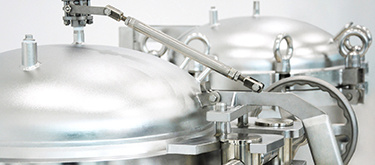
During hydrogen production, mechanical impurities inevitably occur, mainly from metal corrosion products, rust, and dislodged fibers. The alkali filter’s role is to absorb and filter these impurities from the electrolyte to prevent clogging the electrolyzer’s channels, which could cause localized overheating or short circuits.
To extend the filter’s service life, design considerations include reducing the need for frequent lid opening and cleaning, thereby lowering labor intensity and potential injury risks. The filter is equipped with venting holes to prevent air locks, ensuring smooth alkali circulation, and a bypass line for convenient online maintenance.
III. Purification System
High-Purity Gas Filtration (Hydrogen and Oxygen Filters)
These filters remove moisture, impurities, and particulates from hydrogen to ensure high purity. Feature-Tec uses advanced membrane technology with a filtration precision of up to 3 nm, achieving hydrogen purity levels of 99.999% or even higher, ensuring gas quality.
Gas-Liquid Separator (Hydrogen and Oxygen Separators)
Gas-liquid separators, including hydrogen and oxygen separators, prevent alkali solutions from re-entering the electrolyzer when the flow rate is too high and gas separation is delayed. The separator’s pore size, quantity, and alkali inlet height all impact the efficiency of separating gas from the alkali solution.
IV. Water Supply System
Pure Water Filter
In electrolytic hydrogen production, ensuring water purity, especially removing metal ions, is key to the normal operation of the cell stack and achieving high hydrogen purity. Feature-Tec’s strict manufacturing processes control metal ion leaching to ppb levels, ensuring high-quality water for production.
V. Conclusion
With the global pursuit of carbon neutrality, green hydrogen has a promising future. Through various electrolytic hydrogen production technologies and filtration solutions, hydrogen production efficiency and purity can be significantly enhanced, contributing to the transition to clean energy and sustainable development.
Related Solutions
Related components
Related Equipment
Message consultation
Contact
Hotline: (+86)400-820-6150
Email: marketing@feature-tec.com
Address: 8/F, Block A, Building 3, Tianhua Information Technology Park, 299 Longcao Road, Xuhui District, Shanghai
